Secure Hard Drive Disposal for UK Businesses
Hard drives hold confidential information long after the computer, laptop or server they came from has stopped being used. Customer records, employee details, financial documents, archived emails, intellectual property and login credentials can all stay recoverable if a drive isn't processed correctly.
For businesses, hard drive disposal isn't simply a recycling task. It's a data security process that needs controlled handling, a clear chain of custody and reliable evidence that the information on each device has been permanently removed or destroyed.
Green IT Disposal provides secure hard drive disposal for organisations across the UK. We collect loose drives or remove them as part of a wider IT disposal project, then record, process and route each one through the right sanitisation method. Where a drive still works and suits reuse, secure erasure preserves its value and extends its life. Where erasure isn't possible or your policy requires destruction, we destroy the drive through a controlled process.
Why Hard Drive Disposal Needs Specialist Handling
It's easy to assume that deleting files, emptying the recycle bin or formatting a drive removes the data. Usually it only removes the system's reference to it. The underlying information stays recoverable with specialist software or forensic tools, so every old drive that leaves your organisation is a potential risk.
A single drive can hold years of information: files employees thought they'd deleted, temporary system data, cached documents and old user profiles.
The risk isn't limited to desktop hard drives. Data also sits on solid-state drives, server drives, external drives and storage pulled from faulty equipment. Professional disposal makes sure none of these reach a recycling stream before the data is dealt with.
Hard Disk Drives and Solid-State Drives
Different storage media need different sanitisation methods. Traditional hard disk drives (HDDs) store data magnetically on spinning platters. Solid-state drives (SSDs) use flash memory with no moving parts. They do the same job, but they store and manage data differently, so a method that fully clears one may not give the same assurance on the other. The drive's condition, interface, security features and whether it still powers on all affect the correct approach.
We assess each data-bearing device before deciding the route. Functional drives go through specialist erasure. Damaged, inaccessible or policy-restricted drives go to physical destruction. That way we meet the security requirement without destroying equipment that could safely be reused.
Certified Data Erasure
Secure erasure uses specialist software and controlled procedures to overwrite the data on a drive. Unlike a reset or format, it's built to make the original information inaccessible, and the result is verified and recorded. That gives you a reliable audit trail rather than a hope that the data has gone.
Where a drive is successfully erased, we provide certification showing it passed through the agreed process. Depending on your reporting requirements, that documentation can include details linked to the individual asset, so each drive is accounted for by name rather than as a batch. This helps you show that data-bearing equipment was handled properly after it left active use, which matters for compliance reviews, client requirements, information security policies and internal audits.
When Is Physical Destruction Required?
Physical destruction is the right option when a drive can't be securely erased, is badly damaged or is covered by a policy that requires the media to be destroyed. Some organisations also choose it for drives that held highly sensitive data, or where a device can't be connected reliably enough to complete and verify an erasure.
The aim is to damage the data-bearing components so the drive can't be returned to use and the data can't be reached by normal means. We help you choose a proportionate method based on the drive type, its condition, the sensitivity of the data and your own security procedures. Destruction isn't automatically the only secure choice: a working drive that can be fully erased and verified meets the same data security standard while keeping usable equipment in circulation. We assess each drive rather than applying one blanket process, so you get the right balance of security and value on every asset.
A Secure Chain of Custody
Data security starts the moment a drive leaves your premises, not when it reaches a facility. Drives that aren't properly recorded, packed and transported can become hard to trace, and that risk is highest during office clearances and infrastructure upgrades, when storage devices get mixed in with computers, servers and other kit.
We run a managed collection service using our own vehicles, so assets are recorded and moved through a controlled process with accountability maintained from your door to ours. For larger projects, we can review an equipment list or asset register before collection, and separate loose drives from other IT equipment where you need extra control. A documented chain of custody gives you confidence that no drive was misplaced, passed through an unknown third party or processed without the right checks.
Hard Drives Within a Wider IT Clearance
Hard drives often turn up during larger IT disposal projects. Some are still installed in computers, laptops, servers, storage arrays or backup devices. Others have already been pulled by an internal IT team and stored in locked cabinets.
We collect individual drives alongside a wider range of redundant IT: desktops, laptops, servers, network-attached storage, external drives and anything else that can retain data. Handling it all through one managed service simplifies your reporting and saves appointing separate providers for different equipment types. Before collection, it helps to flag any drives that need a specific destruction method or enhanced reporting, so we can build those requirements into the plan.
Meeting Your Data Protection Duty on Storage Media
With hard drives, the data protection question is specific: can you prove the data was destroyed, not just that the hardware was recycled? A drive can be processed as electronic waste and still leave your duty unmet if nobody verified what was on it first. That's the gap that turns a routine disposal into a reportable problem.
Our process closes it by treating the data and the hardware as two separate steps with their own evidence. You get an erasure or destruction certificate proving the data was addressed, plus asset reporting and collection documentation proving the device was tracked and disposed of responsibly. Green IT Disposal is registered with the Information Commissioner's Office and works to recognised quality and environmental management standards, so that evidence supports your retention schedules, offboarding procedures and information security policies. Handled this way, drive disposal sits inside your data governance rather than off to the side as a waste job.
Recycling and WEEE Compliance
Hard drives contain circuit boards, metals and other materials that belong in a controlled recycling process, not general office waste. Sending an intact drive straight into an ordinary recycling stream creates both an environmental and a data security risk, because the media leaves your control before the data is cleared.
As electrical equipment, drives should go through a WEEE-compliant route. Once a drive has been erased or destroyed, we separate the remaining materials and pass them through approved recycling channels, recovering resources while supporting a zero-landfill approach. Where a drive was erased rather than destroyed and remains in good condition, it can be reused or remarketed instead, which keeps a working device out of the waste stream altogether.
Hard Drive Disposal for Professional Organisations
The case for secure drive disposal is clearest in professional and design-led work. Solicitors and legal chambers hold confidential correspondence, case files and client ID documents. Design agencies store unreleased creative work, brand assets and customer credentials. Architects keep plans, tenders and sensitive project information, and production companies manage large libraries of unpublished video and audio.
In these settings a data breach is more than a compliance problem. It affects client trust, commercial relationships and reputation. We work with organisations that need a secure, documented and responsible approach, with a nationwide service focused on Greater London, the North West, the Midlands and the M1 corridor.
Can Hard Drive Disposal Be Free?
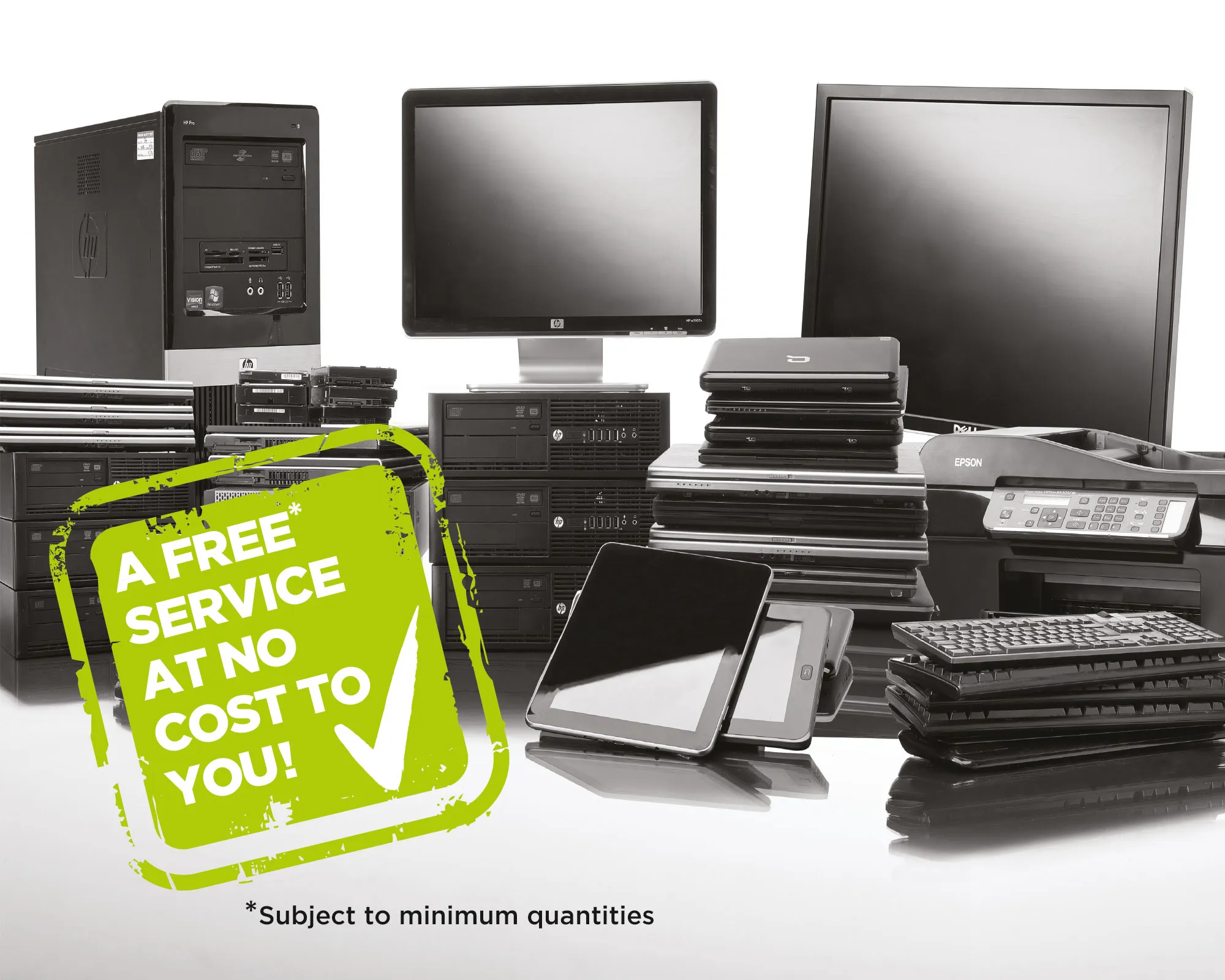
Free disposal may be available as part of a qualifying IT collection, depending on the quantity and type of equipment, its condition, the location and the processing required. Collections that include reusable computers, laptops or servers can help cover the cost of secure transport, erasure, reporting and recycling.
A small batch of loose drives needing physical destruction is assessed differently from a larger collection of reusable equipment, so we review each enquiry individually. Tell us the approximate number of drives, their type and whether they're loose or still installed, and we'll give you suitable advice.
Arrange Secure Hard Drive Disposal
Leaving old drives in storage is an unnecessary risk, especially when records are incomplete and nobody's certain what's on them. Green IT Disposal provides a controlled route covering secure collection, asset recording, certified erasure, physical destruction where required and responsible recycling. By weighing reuse before destruction, we help you cut electronic waste without compromising data security.
Call us on 0161 928 1144 for free advice and a quote, or contact Green IT Disposal to arrange a secure collection.